
Dr. Nsikan Efiok John
August 13, 2026 2026-08-13 11:16Dr. Nsikan Efiok John
FACULTY SPOTLIGHT
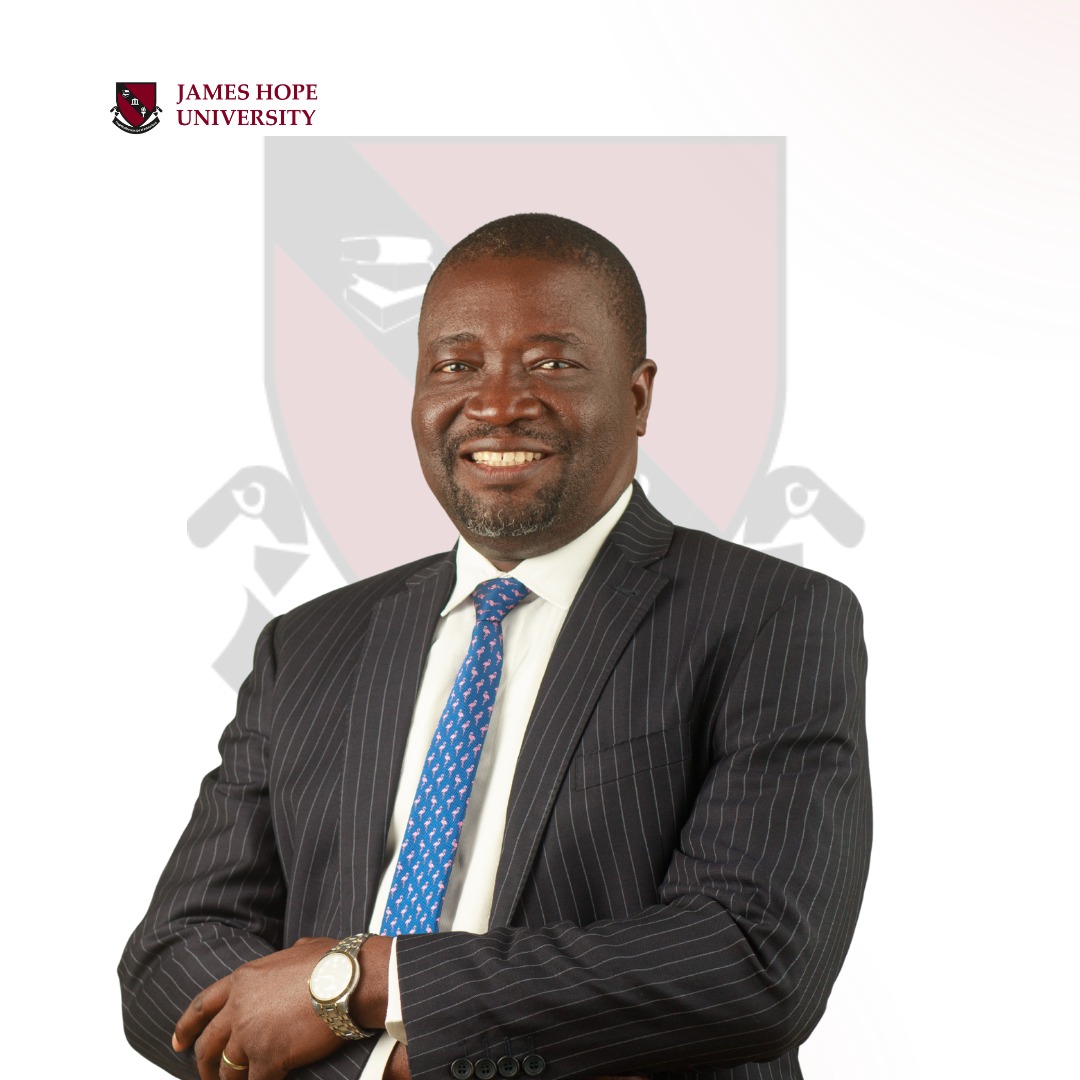
Dr. Nsikan Efiok John
Senior Lecturer & Coordinator, MBA Programmes · James Hope University
3
50→88%
6 yrs
Dr. Nsikan John teaches operations, modelling and problem-solving, supply chain management and quantitative techniques across the school’s MBA (Executive and Regular), MSc in Finance, Fintech & Innovation, and Entrepreneurship programmes. Since the university opened its doors, he has worn three hats: founding Coordinator of Executive Education, MBA faculty member, and Coordinator of the MBA programme, where he runs both its academic and administrative sides. He came to the lecture room by way of the factory floor, and it shows.
THE INTERVIEW
Your academic and professional journey has positioned you as both an educator and leader. What inspired you to pursue a career in academia and business education, and what continues to motivate your passion for developing future business leaders?
I came to teaching the long way round. My first proper job was on the production floor at Flour Mills of Nigeria, planning output and keeping the maintenance schedule from falling apart. That is where I learned what a plan actually costs: not on paper, but in the people who have to scramble when the schedule slips. I spent six years watching clever decisions made in a quiet office land badly on a noisy floor, and it never left me.
Academia was not the plan. What pulled me in was a frustration I kept running into: managers who could recite the theory perfectly and then froze the moment a real problem refused to behave. I thought I could teach the part in between, the bit where you actually reason your way through a mess. So I went back for the master's, then the doctorate, and somewhere along the way teaching stopped being a detour and became the point.
What keeps me here is narrow and specific. It is the moment a student who swore she was “not a numbers person” cracks a problem that frightened her a fortnight earlier. I have seen it often enough to know it is not luck. That, to me, is the whole job: not pouring content into people, but clearing out the fear that stops them thinking straight.
“not a numbers person.”
As the Coordinator of the MBA Programs at James Hope University, how has your experience shaped your approach to academic leadership, curriculum development, and student engagement?
Before I coordinated anything, I championed and administered the JHU Executive Education programmes, and the order matters. Executives are a keen audience, in the best sense. They are busy, they have watched consultants come and go, and they will not sit politely through an abstraction that does nothing for them by Monday morning. Designing and teaching under that kind of scrutiny rewires how you think about the classroom. You stop asking what they should know and start asking what they will actually use in their workplace.
I carried that discipline into the MBA fairly bluntly. Every module has to survive contact with a real problem, and preferably a Nigerian one. Teaching across three different programmes (the MBA, the MSc in Finance and Fintech, and our Entrepreneurship track) turns out to help rather than stretch me. A finance student and a founder look at the same operations problem and see two different things entirely, and moving between those rooms keeps me honest about what is genuinely essential and what is just my own discipline's habit.
Engagement is something I work at on purpose; I do not leave it to chance. I put working professionals into teams that cut across industries, so they are learning from each other and not only from me. I build assessments around problems drawn from their own workplaces, which gives the person doing the work a real stake in the answer. I lean on live cases and simulations rather than long lectures wherever I can, and I make a deliberate point of drawing out the quiet ones, because in a room of adults the most experienced person is often the least noisy. A class of professionals engages the moment it senses the material respects what it already knows, and I try never to lose that.
On the coordination itself, let me be candid: a good half of academic leadership is logistics. Timetables, moderation, making sure a visiting executive has not been double-booked. I refuse to treat that as beneath the work. A programme that is chaotic behind the curtain teaches students something too, just nothing you would want on the syllabus.
The business landscape is constantly evolving. What key skills and competencies do you believe today's MBA students need to succeed, and how do you ensure these are reflected in your teaching?
Let me resist the usual list. Everyone says leadership, communication, adaptability. None of it is wrong, and all of it is so general as to be nearly useless.
Here is what I actually train. First, the ability to take a situation that is noisy, human and a little frightening, and build a small honest model of it: deciding what matters, what you can safely ignore, and what you are choosing to leave out. That last part is the discipline most people skip, and it is the one that bites. A model that forgets what it excluded is a dangerous thing. Second, real comfort with data and, now, with the AI tools everyone is reaching for, held together with enough scepticism to catch the tool when it is confidently wrong. I would far rather graduate a manager who mistrusts a tidy answer than one who is dazzled by it.
I keep this honest by refusing to teach through imported cases about firms in Boston or Munich. We work on problems shaped like the ones my students will walk back into on Monday: a distributor in Aba, a hospital's drug supply in Port Harcourt, a fintech in Lagos trying not to be killed by its own growth. The local context is not decoration around the lesson. It is the lesson.
Looking back on your time at James Hope University, what achievement or milestone are you most proud of, either in the MBA program or in your academic career?
The honest answer is not a publication, though the recent ones mean a great deal to me. It is a number. We moved the pass rate in my quantitative courses out of the low fifties and up into the high eighties. It had been genuinely bad, and that sounds dry until you see what sits underneath it: rooms full of accomplished, working adults who had quietly decided they could not do this, walking out able to. I have built other things I am proud of. I set up our Executive Education function here from a blank sheet. But the pass-rate turnaround is the one I keep returning to, because we did not get there by lowering the bar. We raised it. The students simply stopped being afraid, and it turned out the fear had been doing most of the damage all along.
“Think bigger and expand your market by reaching different groups of people.” — Dr. Ibidunni
Higher education comes with its own unique challenges. Can you share a challenge you've encountered as an academic leader or lecturer and how you successfully navigated it?
The hardest thing I face in the classroom is quantitative fear, and it is more serious than people like to admit. Many of our MBA students are senior professionals who last touched mathematics fifteen or twenty years ago. They arrive at a course full of models and optimisation and decide, somewhere in the first hour, that this part of the programme is simply not for them. Once that verdict is in, no amount of good material gets through.
I lost a couple of early cohorts to this before I understood what was happening. My first instinct had been to slow down and explain more, which only made it worse; it confirmed that the material was as fearsome as they suspected. What finally worked was the opposite. I began every quantitative course with a problem they already knew how to solve by instinct, from running their homes or their businesses, and only then showed them that the intimidating notation was just a neat way of writing down what they had already done in their heads. Start from their competence, not from my content. Nearly all of that pass-rate improvement came from that one change in where I chose to begin.
Beyond the classroom, you contribute to the growth of future business leaders through mentorship and academic leadership. What impact do you hope to make on the next generation of professionals, and what is your vision for the MBA program over the next five years?
Let me begin with the mentoring, because it is the part I take most personally. Supervising a dissertation to a good grade is the easy version of the job; the harder and far better version is refusing to let the work die on a library shelf. This year I have taken research students I supervised and pushed them out to present their own findings at national conferences, standing before a room of their peers and defending work they produced themselves. Watching a nervous student discover that experienced scholars are taking their work seriously does something no classroom grade ever will. We are now working together toward publishing some of that research, with the students named as co-authors rather than tucked into the acknowledgements. That, to me, is what academic leadership actually means: turning students into contributors.
The wider impact I hope to make is inseparable from what I research, so let me be plain about that. My work runs on two convictions that pull against each other, which is what keeps them interesting. The first is that the systems we build in the name of efficiency tend to carry a hidden human cost, and that the cost usually lands on whoever has the least power to refuse it. The second is more hopeful: that digital tools, used well, are one of the few genuine levers we have for softening disruption in a supply chain, for seeing trouble coming, absorbing the shock, and recovering before it cascades. Efficiency can quietly grind people down; digitalisation can help a fragile supply chain stay standing. A good manager has to hold both truths at once, and most of my work sits in the tension between them.
That is what I want my students to become. I have no interest in producing managers who are merely good at wringing a little more out of a tired workforce. I want ones who can run operations that are demanding and humane at the same time, and who can reach for a digital fix without mistaking it for a cure. Knowing the difference is the whole education.
For the programme, my five-year hope is quite specific. I want the James Hope MBA known as the place that takes African operating conditions seriously: the scarcity, the disruption, the informality, the infrastructure that fails on a Tuesday. I want us to teach how digital capability can be bent to fit those conditions, rather than importing assumptions from economies that look nothing like ours. Most management education still treats our reality as a deviation from some tidier norm. I happen to think ours is the more interesting norm, and I want us to teach it as such. If, in five years, our graduates are the ones other firms quietly try to poach because they can keep things running when conditions turn hard, I will count the work as done.
“Being a founder means learning on the job every single day.”
Advice for Current and Aspiring MBA Students: Many professionals aspire to advance their careers through postgraduate education but often hesitate to take the next step. What advice would you give to prospective and current MBA students who want to maximize their learning experience and become impactful leaders?
Most of the hesitation I meet is fear wearing the costume of timing. People tell me they will do the MBA when work calms down, when the children are older, when the economy steadies. None of those things ever quite arrive. The conditions are never clean, and waiting for them is really just a respectable way of saying no.
My other piece of advice is about why you are coming at all. Do not come to collect a certificate. A certificate edits your CV; it does not edit you, and it is the second thing that actually pays off. The students who get the most from us are the ones who arrive willing to be argued with, willing to have a comfortable assumption taken apart in front of them and to sit with the discomfort of it. That discomfort is not a side effect. It is the entire point. If you intend to leave exactly the person you walked in as, keep your money. If you are willing to be changed, there are few better ways to spend a year or two of your life.